
Ft. Blending Techniques - Watercolour
- camilljadecox
- May 26
- 4 min read
Updated: Nov 6

When starting off with a piece of work, it is important that you maintain the vision and image throughout the entire process. It's easy to lose track of the picture, as they say never judge a book by its cover, or a job half done! Maintaining the correct blending techniques throughout, will ensure you are rewarded with a stunning and detailed image, rich in its depth and intracity. From blending to letting it bleed, there are many compositions you can create. Landscapes and fine detail are popular as these allow for the blend of pigment more naturally. From blues and greens (the cold colour palette) to warm hues of orange and red (warm) and the more neutral colours that are trending, it is important the right mediums are used throughout the process, which can be as simple as the right amount of water or the correct level of pigment in the blending process. As I will cover below, it is essential that a sketch is initiated first, as this will serve as the skeleton so to speak, of the overall picture and achieve an overall base in which you can always divert back to.
Watercolour is a magical medium that uses water to carry the paint pigment, drying up to create wonderful effects. But this watery nature can make it harder to create smooth blend, because it dries faster than other mediums like oil, so you have to work fast.
There are many watercolour paints on the market, but using a dry base or a liquid base will provide and achieve the best blending outcome.
The quality will ensure you are using the highest standard of product that will reflect in your overall output of painting.
So here goes! the first step on your journey to understanding the development of a personalised painting no matter if it's for commercial or private use.



Start with your Set-up Stage
The beginning of your masterpiece will always go much smoother if you have all your ducks in a row. This being your paint brushes, graphite pencils, paint colours and the correct paper/art book. It is integral, that you develop an organised space dedicated to your painting process, to ensure everything stays together and you don't invade other individual's space with a variety of stains and colourful catastrophes AKA mess. Use a flat wooden desk, with a paint deflection properties.
I find the 5 base items to include in your studio, before you begin are a blotter (tissues or cotton bud will suffice), graphite pencil HB for detailed pieces (sharpened as you do not want a dark outline when using watercolour), blending medium such as a plastic picnic plate (if you buy a dry based watercolour product, they will already have a blending/mixing slot for you to play around with), the elephant in the room (PAINTS!), two fine paint brushes, one medium, one blotting and one falcon tip and a disposable cup filled half way with fresh clean water (changed every 10 minutes). In reference to the water, the Alkaline soluble that is derived from springs can be used as this contains a certain amount of acidity that is good for dissolving the solid paint quicker.
Choosing good quality paints will make or break your painting and actually have a longer lasting period over time, even when subject to outside elements such as extreme heat or the swinging celsius degree's that manage to creep into the minus's. You have the option of a dry base or a liquid base. It is recommended you use the dry base first as the ratio of water and liquid pigment can change the game throughout.
In the setup phase, it is essential that you start with a clean desk and add your paper centered in the middle. This can be achieved using tape on each side of the paper and limits the warping of the paper.


Brands to invest in - Windsor & Newton, Derwent, Reeves (for the paper) & Staedtler (from experience, they have hard and concrete lead properties).

Paints
Paper
Brushes
Back up your Blending Techniques
Now for the fun and really amazing part of watercolour painting, the blending process.

Blending can involve detailed and infinite linear elements within more acute paintings; how-ever landscapes are more properly executed used a draping and flowing colour blending combination.
Be sure to use your grey-lead for more defined works. Then rub this out later - as this will give your watercolour the delicate appearance.

As Wikipedia defines 'Watercolor or watercolour, also aquarelle, is a painting method in which the paints are made of pigments suspended in a water-based solution."
It is important to use watercolour as your guiding compass within the painting. This means using the water as free for all base in which you can add a variety of coloured pigment and elements to it.
It's a better idea blot the paper out first with water.
The main techniques are as follows.
Wet on wet: Wet watercolor on wet paper to create colorful washes.
Wet on dry: Wet watercolor on dry paper to have more control over paint strokes.
Graded wash: A common approach to blending in watercolor.
Blending colors: Mix colors in the palette to create new colors.
Blending by lifting: Lift color from the paper with a brush or sponge.
Watercolor edge control: Use a double-edged brush to create novelty effects.
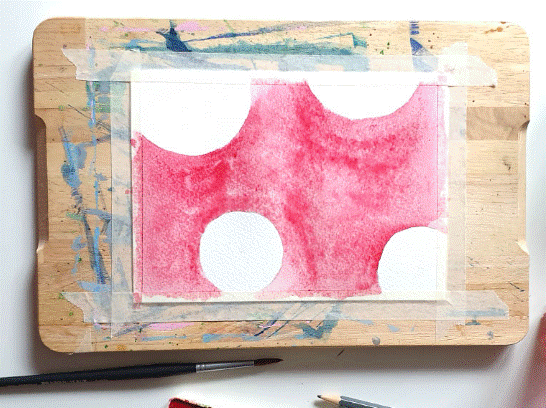
One key technique that is often overlooked, is the ability to block our certain partitions of the painting, often resulting in a clean difference between the paint and the blotted-out paper. The tool used in this instance is the rubber-based material that is produced in liquid form. The best way to use is with a small paintbrush tipped in the latex. Blot out the areas you need with the latex and then leave to try for minimum 2 minutes, which will result in a rubbery coating over the entire area applied. Go ahead and paint continuously and then leave the paint to dry. Once this has been achieved, try to identify which areas became blotted out and then pull off with a tool. Masking fluid, otherwise known as liquid tape or liquid frisket, is a liquid latex type substance that you apply on paper and once dried, you can peel it off. This keeps your paper clean from paint for highlights or whatever you need.

Comments